

In Europe, grocery shopping is a daily habit, not a big weekly trip. Discounters and store brands turned that habit into real efficiency.
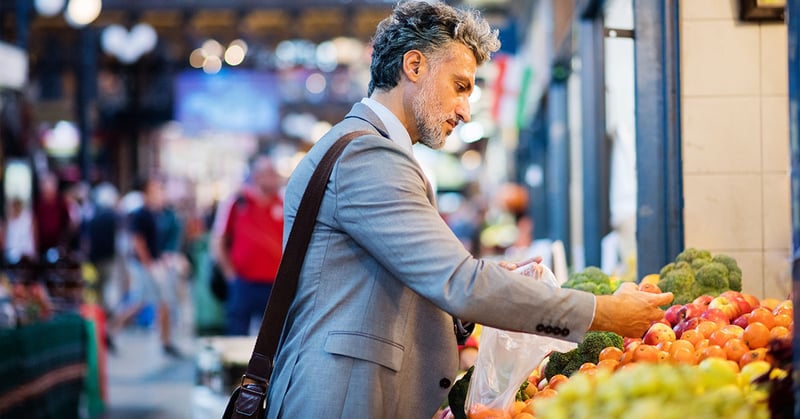
Across Europe, hyper-local supply chains, powerful store brands and compact formats have turned grocery shopping into a model of radical efficiency.
To understand European grocery, stop thinking of shopping as a planned event. From Barcelona to Berlin, it is often part of the journey home, repeated several times a week.
Smaller kitchens, denser cities, fresher expectations and a food culture that treats daily shopping as civic life have kept the European shopper walking to the store long after the American one logged in. Trust in this market lives in the building: in the baker who knows you, in the discounter whose bare shelves certify that nobody is paying for theater.
That rhythm created a model unlike North America’s stock-up mission. Europe is not waiting to become more American. It runs on a different logic: frequency over basket size, curation over abundance and trust earned one trip at a time.
Efficiency the shopper can see
No format expresses this logic more clearly than the hard discounter. Aldi and Lidl did more than establish a successful store model. They changed what efficiency means to the European shopper.
The limited assortment, shelf-ready packaging and stripped-back environment are not experienced simply as cost reductions. They function as evidence. The store appears economical because little space, labor or attention is wasted. A shorter range also turns choice into a promise: the retailer has already done the sorting, and the products that remain should be dependable and sharply priced.
This is why the discounter’s influence extends beyond its own walls. Conventional supermarkets, convenience operators and online grocers all compete against the expectation it created—that operational discipline should reach the customer as value.
In this market, efficiency is not hidden in the back room. It is part of the brand.
Private label as an operating system
Europe’s strong private-label culture follows the same principle. Store brands are not merely cheaper alternatives to national brands. Across many markets, they form the architecture of the assortment.
A good private-label portfolio gives the retailer control over the decisions that matter most: price points, pack sizes, ingredients, quality tiers and the pace of product development. Value ranges defend price credibility. Core ranges carry the weekly shop. Premium, organic and free-from lines allow the grocer to respond to local tastes without surrendering the customer relationship to a manufacturer.
More importantly, private label compresses complexity. Fewer duplicated products can mean faster turnover, simpler replenishment and clearer choices for shoppers. What looks like a branding strategy is also a supply-chain strategy.
That does not make Europe uniform. Germany’s price discipline, the United Kingdom’s sophisticated loyalty and online market, the Nordics’ digital-first store operations and Southern Europe’s devotion to fresh counters all create distinct competitive environments. But the shared advantage is precision: each market has learned to fit the store closely around the life of the shopper.
The fresh-food feedback loop
Europe’s grocery geography also creates a powerful feedback loop. Dense store networks and regional sourcing support frequent visits. Frequent visits support smaller baskets and faster inventory turns. Faster turns make freshness easier to deliver, which gives shoppers another reason to return often.
Regulation and food-waste pressure reinforce the model, but culture matters just as much. When fresh bread, produce, cheese or prepared food is part of a daily routine, the store becomes more than a distribution point. It becomes neighborhood infrastructure.
This is the real source of Europe’s grocery resilience. Trust resides in the trip itself: in the familiar route, the credible price, the compact range and the expectation that tomorrow’s food does not need to be bought today.
Digital must serve the trip
Seen through this lens, Europe’s uneven adoption of online grocery looks less like a maturity gap and more like an economic filter. Delivery must compete with a shopper who may already pass several grocers on the way home. The convenience threshold is higher, while the willingness to absorb extra cost is often lower.
Incisiv's Q3 2026 Grocery Commerce Intelligence reflects this. Of the 85 European brands assessed only three reach the top "Leading" maturity tier. But where digital investment does show up, it tends to land exactly where the trip needs it. Frictionless in-store checkout, the kind of technology that removes friction from a small, frequent basket rather than replacing the trip altogether, is still rare across the region, at 2.4% advanced-or-better maturity, though REWE and Rossmann are already building it.
Digital succeeds when it strengthens the existing ritual rather than trying to erase it: an app that loads a relevant offer before the visit, a loyalty program that behaves like a genuine rebate, electronic shelf labels that keep pricing credible, or checkout technology that removes friction from a small, frequent basket.
The test for any new capability is simple: does it lower the cost, increase the confidence or improve the ease of the next trip?
That is Europe’s trip covenant. Technologies that honor it can spread quickly. Those that ignore it may remain impressive demonstrations in search of a shopper problem.
Europe’s grocery model offers a different view of scale. It appears not only in larger stores or bigger digital baskets, but in the quiet accumulation of frequent, trusted interactions with remarkably little waste.
European grocery has turned that repetition into an institution, making precision part of everyday life.