

Grocery technology has mastered visibility, but the next advantage lies in decision velocity: turning signals into action automatically.
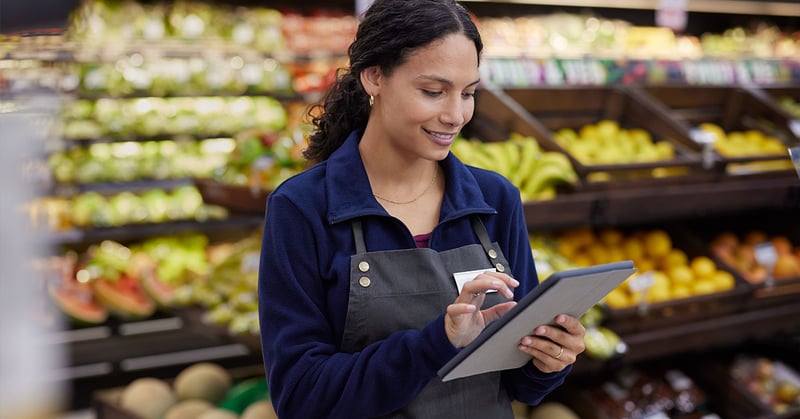
For a century, the grocer watched the shopper decide. The aisle was a laboratory with a roof: the merchant saw the hesitation, the trade-down, the substitution, and what finally entered the basket.
As shopping moved beyond the aisle, that observation became less direct. Digital commerce did not eliminate the signals. It scattered them across search, loyalty, transactions, pricing, promotions, and fulfillment.
Grocery intelligence assembles those fragments. Analytics makes behavior visible. Forecasting anticipates what comes next. Decisioning turns understanding into action.
The value of seeing more
Grocery technology has followed a consistent trajectory: make the business more visible.
Enterprise systems connected operational and financial information. Planning systems brought demand and supply closer together. Analytics platforms made performance easier to monitor and patterns easier to identify.
That progress matters. A grocer cannot make a good decision about a business it cannot see. That foundation remains surprisingly immature. Across the 200 brands assessed in Incisiv’s Q3 2026 Grocery Commerce Intelligence (GCI) only 12.5% demonstrate advanced-or-better maturity in real-time inventory visibility, a capability tied directly to stockout rates and store inventory accuracy. If a system cannot reliably see what is available, forecasting begins with a compromised picture and automated decisions risk acting on the wrong one.
Readiness also varies sharply by format: Drugstores lead at 25%, compared with 9.1% of Supermarkets and just 4.5% of Convenience Stores.
But visibility is a means, not an end. The value of an insight depends on what happens after it appears.
A merchant who discovers that a product is selling faster than expected has information. Understanding why provides context. Knowing what demand may look like tomorrow provides foresight.
The business changes only when someone acts.
From historical averages to dynamic inputs
Consider replenishment.
Traditional forecasting relies heavily on historical patterns: what sold last Thursday, what happened during the same week last year, or how a product performed during the previous promotion.
Those patterns remain useful, but grocery demand is shaped by more than the calendar. Weather shifts demand for produce, beverages, and prepared foods. Local events change traffic. Competitor prices influence switching. Promotions work differently across geographies. A product can lose share to a substitute before the change appears in a weekly report.
The opportunity is not simply to forecast from more history. It is to make forecasting responsive to more of the signals shaping demand now.
This extends the merchant’s field of observation beyond what any individual could reasonably track. The merchant does not need to notice every relevant change. The system does.
The earlier a meaningful change becomes visible, the more options the business has to respond.
Deciding is work
Historically, technology has acted largely as an advisor. It processed point-of-sale data, calculated trends, generated forecasts, identified anomalies, and surfaced recommendations.
A system might tell a manager that fresh berries are selling faster than expected. The manager must still decide whether to increase the order.
That model is changing. For routine, high-frequency decisions, software can increasingly move through the entire loop:
sense the change → evaluate the implications → determine a response → execute it → monitor the result.
In replenishment, that can mean turning a demand signal into an order rather than an alert. In pricing, it can mean adjusting a price within defined guardrails instead of sending a recommendation for review. In markdowns, it can mean acting when inventory and time-to-expiry cross a threshold rather than waiting for the next planning cycle.
Decision support gives a person something to do. Decision execution does something for the person.
That is the point at which technology begins to transfer work.
A dashboard can reveal a hidden pattern, bring fragmented information together, and help a merchant understand the business. But it does not necessarily transfer decision work. Someone may still need to interpret the signal, determine what matters, secure approval, and execute the change.
The better questions are:
- What decision does the system change?
- How frequently is that decision made?
- How much human effort does it consume?
- How expensive is the delay between signal and action?
- Can the system carry the decision through to execution?
The answers reveal whether a product is improving visibility or changing the economics of the operation.
The decisions hiding inside the P&L
Grocery contains thousands of decisions that are individually small but collectively expensive. One order adjustment, price check, exception review, or markdown may seem insignificant. Multiplied across products, stores, and trading periods, they become a substantial workload.
The opportunity is not to replace the merchant’s most sophisticated judgment. It is to remove the routine decisions surrounding it. Automated pricing can respond across an assortment without requiring someone to inspect every movement. Timely markdowns can preserve value that delay destroys. A forecast can become an order before the next planning cycle.
The value comes from three places: better decisions, faster decisions, and fewer decisions requiring human intervention.
Closing the loop
These decisions also affect one another. A promotion changes demand; demand changes inventory; inventory affects fulfillment and customer experience. Yet merchandising, supply chain, and retail media often act through separate systems.
A connected decisioning layer can coordinate the response. If a promotion accelerates demand, replenishment can adjust. If availability deteriorates, the business can reduce promotion or media exposure instead of creating demand it cannot fulfill.
Where automation should stop
Not every decision belongs with software. Automation works best when decisions are frequent, measurable, bounded by clear objectives, and easy to monitor or reverse. Human judgment matters more when choices are strategic, unusual, ambiguous, or difficult to undo.
The merchant’s role therefore moves up the stack: from approving every order, markdown, or price change to defining the objectives, rules, thresholds, constraints, and exceptions within which the system operates.
Expertise does not disappear. It moves into the design and governance of the decision system.
A new measure of intelligence
Better visibility, analytics, and forecasts still matter. But the more consequential question is what happens between signal and action.
A stronger measure is how much useful work a system can safely perform: replenishment decisions executed, prices changed within guardrails, markdowns completed, or merchant hours returned.
Analytics makes behavior visible. Forecasting makes it predictive. Decisioning makes it actionable. The point is not simply to know more, but to act earlier and determine which actions still require human judgment.
The most valuable merchant of the future may not be the person who makes the most decisions. It may be the person who knows which decisions should no longer need to be made manually.